


In July this year, the Perak government appointed a joint venture (JV) between Gamuda Bhd (KL:GAMUDA) and Perbadanan Kemajuan Negeri Perak (PKNPk) to develop and operate water treatment and distribution infrastructure in Kerian, Northern Perak; supply and distribute water to Kerian Integrated Green Industrial Park (KIGIP); and sell excess treated water to Penang under the RM5 billion Northern Perak Water Supply Scheme (NPWSS).
For Gamuda, this is a significant undertaking, marking its homecoming, as the company was founded and incorporated in Ipoh in 1976. Executive director Datuk Azmi Mat Nor says the company now has the opportunity to contribute to the state’s development from the talent, expertise and economic perspectives.
Building up the local community and workforce through talent development is a key focus for Gamuda. The objective is to contribute expertise and resources to advance the state as well as invigorate its economy by contracting and training local contractors, and building a consistent and robust supply chain pipeline.
“Across all our projects, we prioritise working with at least 90% of local suppliers each year, as we seek to foster a fair and inclusive supply chain that supports women and marginalised groups,” Azmi says.
“We carry this objective seriously to make sure that the local supply chain and local businesses, particularly small and medium enterprises (SMEs), are going to benefit hugely from this project. We have several concrete initiatives on this front.”
The NPWSS, a strategic and transformative initiative by the Perak and federal governments, aims to address the long-standing water shortage for irrigation, domestic and industrial use in Northern Perak. Under the terms of appointment, the PKNPk-Gamuda JV has a 40-year concession period.
“Construction completion is 2030, which is important to address Penang’s projected deficit, as per the report published by Kementerian Alam Sekitar dan Air (KASA) in 2022. For Perak, this critically secures long-term water for the irrigation needs of Northern Perak; and supply for the upcoming KIGIP. This agreement meets the water needs of both states and aligns with our Perak Sejahtera 2030 core principle: managing water, our most valuable ‘Khazanah’, for the economic benefit of Perak by creating a new, long-term revenue stream for the next 40 years,” says Perak Menteri Besar Datuk Seri Saarani Mohamad.
The NPWSS scheme is designed to transfer 1,500 million litres per day (MLD) of raw water from Sungai Perak to the Bukit Merah Dam. Of this, 500 MLD of raw water will be allocated for the immediate irrigation needs of Northern Perak, with the balance made available for treatment to meet the domestic and industrial demands of the state.
KIGIP is set to be a transformative project for agriculture-based Northern Perak, which has seen new economic activity recently. Having a stable water supply will foster more eco-friendly industrial practices, support green technology initiatives and contribute to regional economic growth through job creation, increased productivity and the establishment of sustainable industrial ecosystems.
Datuk Redza Rafiq Abdul Razak, chief executive of PKNPk, emphasises the project’s significance to Perak as it improves irrigation reliability, domestic supply and industrial capacity. “It is not merely an engineering feat but a socio-economic catalyst that will enable increased agricultural productivity, deliver a stable water supply to households, strengthen industrial investment in areas such as KIGIP, and create new employment and business opportunities.
“By enhancing water security with a steady supply, the project lays a solid foundation for sustainable growth and improved quality of life for the people of Perak,” he adds.
On the agricultural front, NPWSS provides for irrigation and supplying water to local communities. Once Perak’s own requirements are fulfilled, excess treated water will be sold to Penang.
Azmi says the spillover effect will provide Penang with a new and stable source of treated water to meet the state’s demand. As it is recognised as Malaysia’s leading manufacturing and electrical and electronics (E&E) hub, Penang needs to ensure that it has a sufficient water supply.
“Penang’s industrial zones need large and consistent volumes of high-quality water for manufacturing, cooling and precision-cleaning processes. With NPWSS, the excess treated water supply to Penang will be able to support its industrial zones, safeguarding the state’s position and continuity as a key contributor to Malaysia’s export-driven economy,” he says.
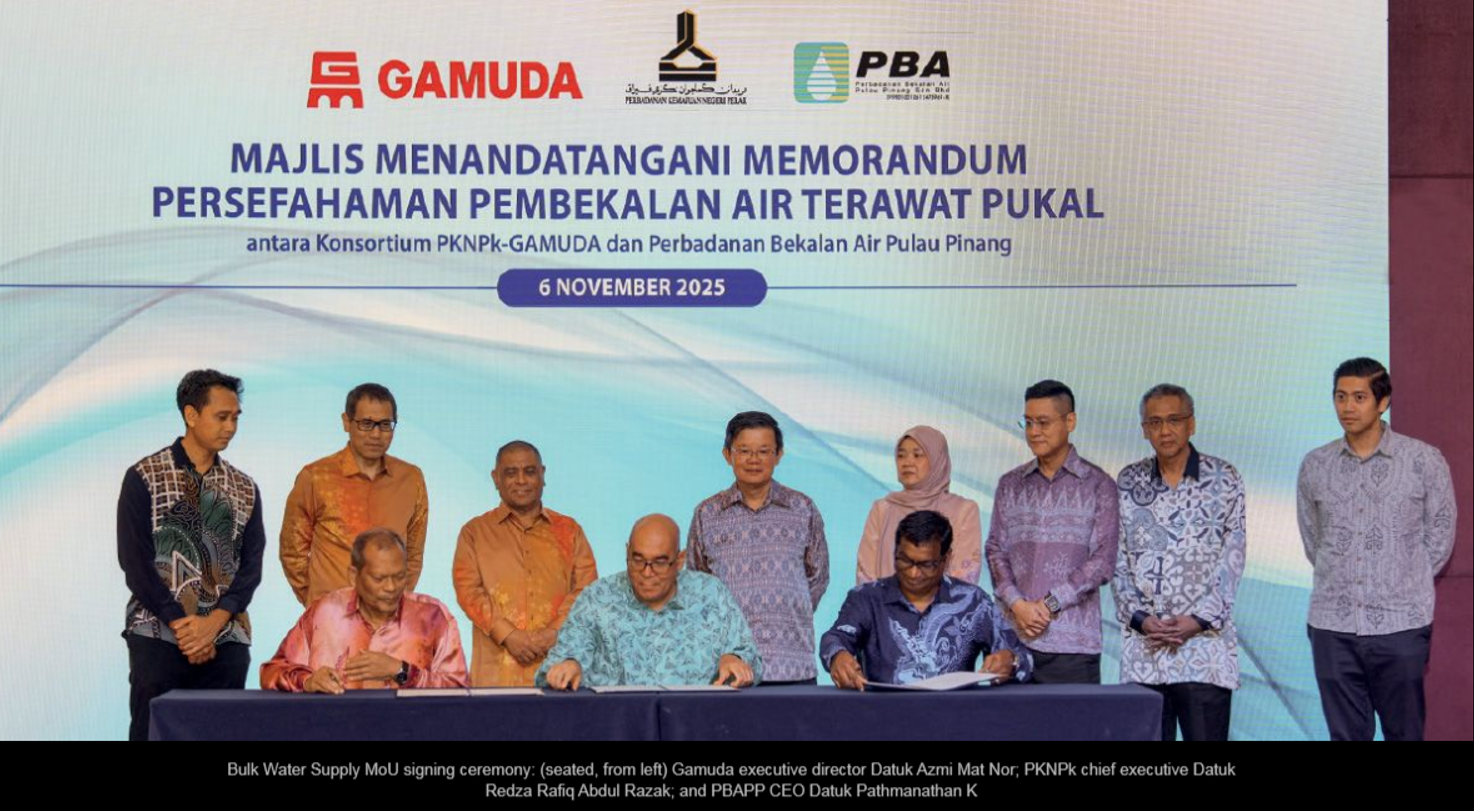
In November, supplier PKNPk-Gamuda JV and buyer Perbadanan Bekalan Air Pulau Pinang Sdn Bhd (PBAPP) signed a landmark memorandum of understanding (MoU) for the sale of the excess treated water.
Supporting Perak’s Water Security
01 Dec 2025, 08:00 am

Bulk Water Supply MoU signing ceremony: (seated, from left) Gamuda executive director Datuk Azmi Mat Nor; PKNPk chief executive Datuk Redza Rafiq Abdul Razak; and PBAPP CEO Datuk Pathmanathan K
In July this year, the Perak government appointed a joint venture (JV) between Gamuda Bhd (KL:GAMUDA) and Perbadanan Kemajuan Negeri Perak (PKNPk) to develop and operate water treatment and distribution infrastructure in Kerian, Northern Perak; supply and distribute water to Kerian Integrated Green Industrial Park (KIGIP); and sell excess treated water to Penang under the RM5 billion Northern Perak Water Supply Scheme (NPWSS).
For Gamuda, this is a significant undertaking, marking its homecoming, as the company was founded and incorporated in Ipoh in 1976. Executive director Datuk Azmi Mat Nor says the company now has the opportunity to contribute to the state’s development from the talent, expertise and economic perspectives.
Building up the local community and workforce through talent development is a key focus for Gamuda. The objective is to contribute expertise and resources to advance the state as well as invigorate its economy by contracting and training local contractors, and building a consistent and robust supply chain pipeline.
“Across all our projects, we prioritise working with at least 90% of local suppliers each year, as we seek to foster a fair and inclusive supply chain that supports women and marginalised groups,” Azmi says.
“We carry this objective seriously to make sure that the local supply chain and local businesses, particularly small and medium enterprises (SMEs), are going to benefit hugely from this project. We have several concrete initiatives on this front.”
The NPWSS, a strategic and transformative initiative by the Perak and federal governments, aims to address the long-standing water shortage for irrigation, domestic and industrial use in Northern Perak. Under the terms of appointment, the PKNPk-Gamuda JV has a 40-year concession period.
“Construction completion is 2030, which is important to address Penang’s projected deficit, as per the report published by Kementerian Alam Sekitar dan Air (KASA) in 2022. For Perak, this critically secures long-term water for the irrigation needs of Northern Perak; and supply for the upcoming KIGIP. This agreement meets the water needs of both states and aligns with our Perak Sejahtera 2030 core principle: managing water, our most valuable ‘Khazanah’, for the economic benefit of Perak by creating a new, long-term revenue stream for the next 40 years,” says Perak Menteri Besar Datuk Seri Saarani Mohamad.
The NPWSS scheme is designed to transfer 1,500 million litres per day (MLD) of raw water from Sungai Perak to the Bukit Merah Dam. Of this, 500 MLD of raw water will be allocated for the immediate irrigation needs of Northern Perak, with the balance made available for treatment to meet the domestic and industrial demands of the state.

Rasa and Bukit Badong Water Treatment Plants provide clean and safe water for Malaysia’s biggest cities. Rasa supplies 250 MLD and Bukit Badong, 800 MLD.
KIGIP is set to be a transformative project for agriculture-based Northern Perak, which has seen new economic activity recently. Having a stable water supply will foster more eco-friendly industrial practices, support green technology initiatives and contribute to regional economic growth through job creation, increased productivity and the establishment of sustainable industrial ecosystems.
Datuk Redza Rafiq Abdul Razak, chief executive of PKNPk, emphasises the project’s significance to Perak as it improves irrigation reliability, domestic supply and industrial capacity. “It is not merely an engineering feat but a socio-economic catalyst that will enable increased agricultural productivity, deliver a stable water supply to households, strengthen industrial investment in areas such as KIGIP, and create new employment and business opportunities.
“By enhancing water security with a steady supply, the project lays a solid foundation for sustainable growth and improved quality of life for the people of Perak,” he adds.
On the agricultural front, NPWSS provides for irrigation and supplying water to local communities. Once Perak’s own requirements are fulfilled, excess treated water will be sold to Penang.
Azmi says the spillover effect will provide Penang with a new and stable source of treated water to meet the state’s demand. As it is recognised as Malaysia’s leading manufacturing and electrical and electronics (E&E) hub, Penang needs to ensure that it has a sufficient water supply.
“Penang’s industrial zones need large and consistent volumes of high-quality water for manufacturing, cooling and precision-cleaning processes. With NPWSS, the excess treated water supply to Penang will be able to support its industrial zones, safeguarding the state’s position and continuity as a key contributor to Malaysia’s export-driven economy,” he says.
In November, supplier PKNPk-Gamuda JV and buyer Perbadanan Bekalan Air Pulau Pinang Sdn Bhd (PBAPP) signed a landmark memorandum of understanding (MoU) for the sale of the excess treated water.

PKNPk and Gamuda exclusive arrangement: A joint venture between Gamuda and Perbadanan Kemajuan Negeri Perak (PKNPk) accepted a letter of appointment from the Perak government to develop and operate water treatment and distribution infrastructure in Kerian, Northern Perak
The pivotal agreement establishes the terms, specifically the price, quantity and supply tenure, which will serve as the basis for the definitive Bulk Water Supply Agreement (BWSA) to be entered into between the two entities. They intend to execute the BWSA within six months, subject to the relevant authorities’ approval.
Once finalised, the BWSA will fundamentally enhance Penang’s water security with at least 300 MLD of treated water starting in 2031. This development is crucial as it reduces the state’s reliance on Sungai Muda, and provides enhanced surety beyond the Water Contingency Plan 2030.
This is crucial for Penang’s ability to continue to attract high-value investments, which will support its local economy and industrial growth for decades to come.
This project is also perfectly aligned with the new public investment strategy outlined in Budget 2026. Through this alignment on the key commercial terms, the JV has a commercially viable project that can be flexibly funded via federal financing or a public-private partnership (PPP) arrangement.
Bringing water and construction expertise to the table
The collaboration between PKNPk and Gamuda is a convergence of complementary strengths. Redza Rafiq says PKNPk, as the state’s economic development agency, brings vast development, experience and an in-depth understanding of regional priorities, governmental regulatory representation, local socio-economic conditions and stakeholder ecosystems.
Gamuda, on the other hand, brings in world-class engineering, project management and operational expertise. Together, this combination ensures that the project is not only technically sound but also socially inclusive and economically meaningful.
“From an operational standpoint, Gamuda’s capabilities in advanced engineering and digital integration support PKNPk’s objective of delivering innovative and sustainable infrastructure,” he says.
Faris Mohd Yusof, executive director of Gamuda Engineering, says Gamuda is humbled by the opportunity to bring its water infrastructure expertise to its home state, taking into account its track record and experience in various types of water projects, treatment plants, distribution networks and infrastructure concessionaire, which positions the company well to deliver this piece of essential infrastructure to the region, as well as manage it.
An important component of the project is Gamuda’s digital-first approach, which focuses on innovation and the involvement of SMEs in the local supply chain, enabling knowledge transfer. One such instance is building information modelling (BIM), an intelligent 3D model-based process that gives architecture, engineering and construction professionals the insight and tools to collaboratively plan, design, construct and manage buildings and infrastructure. It combines technology with a set of work processes that involve designing a building or piece of infrastructure collaboratively using one coherent system of virtual models rather than separate sets of drawings.
“While executing the project, the SMEs involved will have to follow the elevated practice and process for construction, hence, we are directly and indirectly training the local community and elevating their industry standards,” says Faris.
There are also plans to formally put in place programmes and mechanisms for skills and technology transfer.
“It was practised in our previous projects, like the MRT projects, where we had the involvement of technical and vocational education and training (TVET) students and trained them to become specialists with things like the autonomous tunnel boring machine (TBM),” he explains.
Digital construction aspects are present in all of Gamuda’s projects, says Faris. Digitalising construction ensures better project delivery and risk management by using a unified, cloud-based system that allows for real-time tracking of progress and safety, which provides actionable insights for proactive issue resolution and management.
This is reflected in Gamuda’s construction teams and in-house deployment of digital innovations such as Gamuda’s award-winning autonomous TBM software, which allows automatic and more accurate insights. Technologies, such as the BIM-augmented reality (BIMAR), significantly reduces human error.
Combined with Gamuda’s experience and expertise, the drive to innovate allows those working on the project to accurately predict potential cost impacts and delays and address them accordingly.
This same digital-first approach extends to Gamuda’s operation and maintenance (O&M) in water treatment, where it is applying its digital expertise to optimise operational performance. This digital approach is also a key part of its strategy for Non-Revenue Water (NRW) management.
Talent a crucial part of the supply chain
Supporting the development of the local workforce and communities will remain Gamuda’s focus. Faris says value is added into the operations when they are able to train talent to contribute to the local supply chain.
This is where Gamuda’s skills and knowledge transfer happens, allowing talent to explore and widen their skill sets and expertise. “As a leading infrastructure builder, we provide training and development programmes to reskill and upskill employees and the supply chain regionally through all our projects,” he says.
The company’s Gamuda Plant Operator School (GPOS), which was established in 1997, streamlines the different competency levels of crane and earthmoving plant operations in Malaysia. Over 45,000 people have been trained at GPOS, as many as 80% of Malaysia’s certified crane operators.
The establishment of Gamuda AI Academy in 2024 also marks the group’s strategic shift towards digital construction and advancing Malaysia’s engineering ecosystem. In collaboration with Google Cloud, the AI academy was the first of its kind in Malaysia’s construction industry. It seeks to bridge the AI talent gap, fuelling innovation and aligning with national digital transformation goals.
“The academy allows Malaysians to upskill themselves and become tech-savvy in AI literacy, giving a competitive edge in the workforce,” says Faris.
With campuses in both Kuala Lumpur and Kota Kinabalu, Sabah, Gamuda AI Academy has produced over 200 graduates to date.
“With our graduated cohorts, we have the capabilities to teach and upskill local players in Perak so that they can adopt AI into their construction methods, leading to further developments in the local workforce,” he adds.
https://theedgemalaysia.com/content/advertise/supporting-peraks-water-security

