


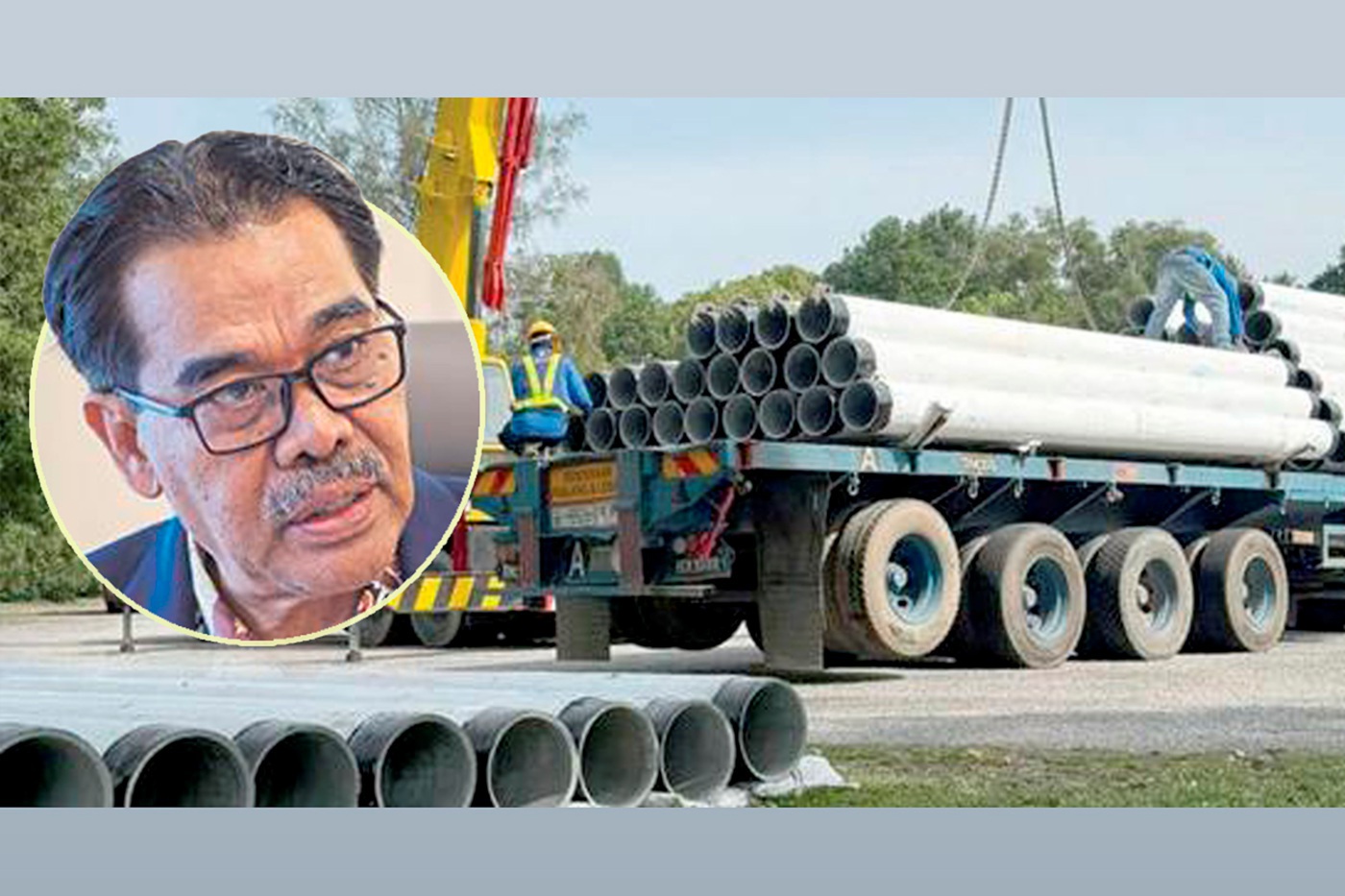
39,000km of pipes 'living' on borrowed time [WATCH]
February 22, 2026 @ 5:45am
Get breaking news fast — follow us on WhatsApp and Telegram.
KUALA LUMPUR: States must review their water tariff structure to fund the replacement of ageing asbestos cement (AC) pipes — a move that could cut non-revenue water (NRW) losses by up to 70 per cent and ensure long-term sustainability of the country's water supply.
In an exclusive interview with the New Straits Times, Pengurusan Aset Air Bhd (PAAB) chairman Datuk Seri Jaseni Maidinsa said nearly a third of Malaysia's water pipelines are already beyond their designed lifespan.
"The Energy Transition and Water Transformation Ministry has identified 39,287km of AC pipes nationwide that are beyond their designed lifespan. This accounts for 28 per cent of the country's entire pipeline network. We aim to replace all AC pipes by 2050."
-ADVERTISEMENT-
These pipes are designed to last about 30 years, but many have been in use for more than 50 years.
"They have become brittle. When there is heavy loading or excessive distribution pressure, they will break or leak. Even if they do not burst, they can develop small leaks that are difficult to detect."
Jaseni said AC pipes are no longer used by water operators in Malaysia and the main issue now is replacing the existing ones.
PAAB, he added, only uses materials approved by the National Water Services Commission (Span), taking into account site conditions, soil type and environmental exposure.
"For example, in coastal areas, you cannot install steel pipes because of the saltwater exposure," he said.
Replacement materials include mild steel, ductile iron and high-density polyethylene (HDPE), all of which require Span approval.
HEFTY PRICE TAG, BUT DELAYS ARE COSTLY
Jaseni said replacing all ageing AC pipes nationwide may cost around RM57.8 billion as it extends beyond just piping materials.
"Pipe replacement is not just about laying new pipes. You have to excavate, reinstate roads, relocate utilities such as Tenaga Nasional Bhd (TNB) cables and telecommunications lines, and manage traffic. These contribute significantly to the cost."

However, he said delaying pipe replacements would only worsen NRW losses and increase long-term costs.
"The biggest contributors to NRW are pipe bursts, leakages, reservoir overflows and water tank overflows, often occurring at night due to faulty valves. So, replacing the old pipes alone can reduce NRW losses by 50 to 70 per cent," he said.
PIPE REPLACEMENT PRIORITY
Jaseni said PAAB uses only pipes approved by Span and supplied by contractors that are not blacklisted.
"We then look at areas with high water losses. If the pipe diameter is large and the water loss is significant, it must be replaced first," he said.
Other key criteria include the frequency of supply interruptions, the number of complaints, population density and whether the pipeline supplies critical facilities, such as hospitals, industrial estates, airports and hotels.
"If a pipeline has burst repeatedly along the same road and complaints keep coming in, that pipeline must be replaced as a priority," he added.
HEART OF THE PROBLEM
The ministry has set a goal of reducing NRW from 34.3 per cent to 28.8 per cent by 2030.
Among the states with the highest NRW losses are Perlis (61.5 per cent), Kelantan (53.7 per cent), Kedah (51.1 per cent), Pahang (48.6 per cent) and Terengganu (40.2 per cent).
Jaseni said the main obstacle to reducing NRW losses nationwide is not technology, but outdated funding and tariff structures.
"The main issue is funding. Water tariffs in all states have not achieved full cost recovery. When operators try to review tariffs, the issue becomes politicised and state governments become reluctant to approve the increases," he said.
As a result, water operators struggle to replace pipes, repair leaks promptly or build competent NRW management teams.
"When repairs are delayed, even more water is lost. Operators also lack the manpower, hardware and software to implement holistic NRW management."
Holistic NRW management includes 24-hour call centres, repair teams, and geographic information systems. It also involves supervisory control and data acquisition software, telemetry systems, hydraulic modelling, pressure management, district metering zones, and active leakage control.
"You need both pipe replacement and holistic NRW management. Without data, you will not know which pipes to replace or where failures occur most frequently," he said.
FINANCING MODEL
Since 2010, PAAB has allocated RM2.78 billion to replace 4,516km of AC pipes, but only in states where water operators are financially stable.
"When PAAB wants to replace a pipe, we hand the materials over to the water operator, who then repays us over 45 years. We raise the money through sukuk.
"Financially stable operators must review their water tariffs to pay for capital expenditure outlined in their five-year business plans. If tariffs are not reviewed, how can they repay?" Jaseni said.
On whether structural changes are needed to accelerate nationwide replacement, Jaseni said the answer is clear.
"There must be timely and accurate water tariff reviews. When operators submit their five-year business plans, they should indicate the projects they intend to undertake.

"These plans are then translated into financial requirements. From there, the required tariff review is derived to fund the projects and the proposal is submitted to Span."
Span, he added, plays a critical role in evaluating proposed projects before recommending tariff adjustments to the cabinet to be approved and gazetted.
"However, in some cases, state governments are either unwilling to proceed or revise their proposed tariff downwards. When this happens, water operators do not have sufficient funds. This is the main issue."
FULL-COST RECOVERY BY 2050
PAAB's long-term goal is to see the water services industry achieve full cost recovery by 2050.
"By then, water tariffs should be sufficient to cover operating costs, capital expenditure and reasonable profits approved by Span. Only then can the industry stand on its own."
Jaseni said PAAB operates under the four phases of migration, stabilisation, consolidation and full-cost recovery.
"At present, we are in the stabilisation phase. We are spending a significant amount on capital expenditure and collecting lease payments from water operators.
"As we move into the consolidation and full-cost recovery phases, there will be less construction and more emphasis on collection.
"Engineering requirements will decrease, whereas financing will become prominent. Ultimately, we aim to achieve full-cost recovery by 2050."
Jaseni said PAAB is also aiming to sustain the treated water reserve margin where operators are required to maintain a minimum reserve margin of 15 per cent to cater to peak demand, such as during festive periods or dry season.
In achieving this, he said, PAAB plans to execute initiatives such as water treatment plant residue management to extract water from residue generated during the water treatment process, as well as recycling industrial water and wastewater from Indah Water Konsortium.
"Industrial water recycling is necessary because water demand has continued to rise, while surface water sources, such as rivers and dams, are slowly decreasing.
"These measures are aimed at maintaining the treated water reserve margin. Future options include rainwater harvesting and seawater desalination."
However, he said, all these initiatives require new technologies and higher costs.
"Therefore, water tariff reviews must be properly planned. When new technologies and additional costs are introduced, tariffs must be reviewed accordingly.
"Otherwise, water operators will not be able to implement these measures, and the government will have to bail out the system indefinitely," he added.


https://www.nst.com.my/news/nation/2026/02/1382474/39000km-pipes-living-borrowed-time-watch

